
Self-Assessment Score: 95
Throughout EDLD 5389 Developing Effective Professional Leadership and EDLD 5318 Instructional Design in Online Learning, I have grown significantly as a self-directed learner. These two courses became a powerful combination because each one required me to apply concepts rather than simply understand them. Together, they allowed me to see how intentional design, clear purpose, and effective professional learning can truly shape real classroom change. For this reason, I am assigning myself a score of 95, which I believe accurately reflects my contributions to my own learning and to my learning community.
What Worked Well in My Learning Process
One of the strongest parts of my learning in both courses was my ability to revise and refine all my assignments based on feedback. In EDLD 5389, my Alternative PL Strategy, my PL Outline, and my final Connecting and Communicating Your Ideas page truly evolved over time. Each revision pushed me to think more deeply about how Gulamhussein’s principles apply to early childhood teachers and how the Go & Show model can humanize professional learning.
Links to examples:
- PL Strategy Drafts – [insert link]
- Alternative PL Presentation – [insert link]
In EDLD 5318, I strengthened my instructional design thinking by creating learning environments that follow UbD, authentic assessment, and COVA/CSLE. I especially enjoyed building my modules and templates because I could visualize how my innovation Tech Time: My Time in Kindergarten will look when teachers apply it.
Links to examples:
- Instructional Design Plan – [insert link]
- UbD Template – [insert link]
Both courses helped me connect the “why,” “how,” and “what” in very meaningful ways. EDLD 5389 pushed me to lead with clarity and purpose, while EDLD 5318 gave me the structure and design logic to turn ideas into long-term learning experiences. When combined, the two courses made me understand that any successful PD or online learning environment must begin with purpose, evolve through design, and stay grounded in relevance and authenticity.
Collaborations and Base Group Contributions
My base group was an important part of my learning experience. I consistently collaborated with:
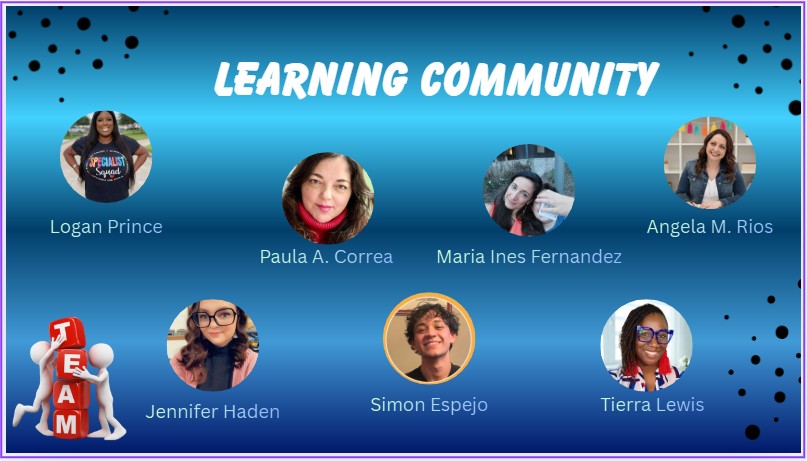
Every week, we shared drafts, clarified rubrics, gave feed-forward, and offered emotional support. Even when I was recovering from unexpected gallbladder surgery and was unable to sit or walk comfortably for nearly two weeks, my group remained supportive, and I made sure to continue participating as soon as I was physically able to work without pain. Although I was temporarily slowed down, I stayed committed to meeting deadlines and completing all readings, videos, and discussions because I value the accountability and trust built within this community.
I provided peer feedback through Google Docs comments, GroupMe chats, and discussion forums. I also offered suggestions on structure, APA formatting, narrative tone, clarity of purpose, and slide organization for several classmates. Our group dynamic was supportive, uplifting, and academically productive. It felt like a true learning community rather than just a requirement.
Supporting Contributions
I consistently posted in forums in a timely manner to allow others to respond. My postings incorporated research, course readings, and specific examples from my innovation plan. I also revised all my assignments and reflected on how those revisions strengthened both my learning and my ability to design professional learning experiences.
In both courses, I took informal leadership roles by asking clarifying questions, sharing resources, and helping classmates understand assignment expectations. I also participated in every course activity and submitted work that aligned with APA guidelines and demonstrated depth of thinking, especially regarding authentic learning, COVA, PL design, and instructional planning.
What I Can Continue to Improve
Although I met all key contributions, my surgery interrupted my workflow and limited the amount of time I could spend giving extended feed-forward in some weeks. This is why I do not assign myself a score of 100. I contributed consistently and responsibly, but there were moments when my physical recovery prevented me from being as active as I would normally be. I believe a score of 95 honors both my strong contributions and the reality of my temporary limitations.
Final Reflection
These two courses have been among my favorites in the ADL program because they allowed me to see the full picture of what meaningful learning really requires. EDLD 5389 helped me understand how professional learning succeeds when it follows purpose, relevance, modeling, and ongoing support. EDLD 5318 showed me how intentional instructional design can transform ideas into structured, evidence-based learning experiences that truly support teachers and students.
Together, they strengthened my confidence as an educator, designer, leader, and collaborator. I am leaving these courses with clarity, purpose, and a deeper understanding of how to create learning experiences that are intentional, authentic, and transformative—for teachers, students, and myself.
Self-Assessment Score: 95
📚 References
Fink, L. D. (2013). Creating significant learning experiences: An integrated approach to designing college courses (Rev. ed.). Jossey-Bass.
Gulamhussein, A. (2013). Teaching the teachers: Effective professional development in an era of high stakes accountability. Center for Public Education.
Harapnuik, D. (n.d.). Assessment as learning [Video]. YouTube. https://youtu.be/WLmxREQLizk
Harapnuik, D. (n.d.). Contributions to your learning and the learning community [Video]. YouTube. https://youtu.be/WT4ZHFW6d48
Horn, M. (2015). Disrupting class – Part 3 [Video]. Clayton Christensen Institute.
Ottawa Catholic School Board. (2013). Innovation that sticks: Risk taking [Video].
Robinson, K. (2010). Bring on the learning revolution [Video]. TED Conferences.
Wiggins, G., & McTighe, J. (2005). Understanding by design (Expanded 2nd ed.). ASCD.