
Self-Assessment Score: 97
As we conclude EDLD 5318, I am grateful for how much I have grown throughout this learning experience. This course challenged me to think deeply about what meaningful online learning truly looks like and how to design with purpose, empathy, and clarity. After reflecting on my engagement, consistency, collaboration, and willingness to revise and improve my work, I rated myself a 97 for this class. I believe this score accurately reflects the effort, commitment, and dedication I invested in every assignment.
Fink (2013) explains that meaningful learning requires students to become self-directed, reflective, and actively engaged in assessing their own work. This idea reflects exactly how I approached this course and why I feel confident in the score I selected.
Why I Selected This Score
Throughout the course, I completed all assignments on time and often early, and made revisions based on feedback from peers and my instructor. I participated in all discussions, responded thoughtfully to classmates, and engaged actively in strengthening our learning community. I also reached out beyond the course platform by supporting classmates through GroupMe, answering questions, and helping clarify expectations when someone felt uncertain or overwhelmed.
This course required discipline, especially as I balanced teaching full-time, managing family responsibilities, and recovering from surgery. Many nights I worked after my children went to bed, during my planning period, or on weekends, determined not only to complete tasks but to understand why we were doing them. That mindset connecting purpose to practice is what helped me truly grow as a self-directed learner.
What Supported My Growth
One of the habits that made a big difference was intentionally starting assignments early. This allowed me time to rewatch videos, revisit readings, revise my work, and make improvements without stress. I consistently completed all course materials, and each reading or video helped me understand the reasoning behind our design choices, especially the role of COVA, CSLE, usability principles, and thoughtful multimedia integration.
Another factor that supported my learning was actively giving and receiving feedback. Reading my classmates’ ideas helped me refine my own thinking, and their comments on my work guided my revisions. This cycle of continuous improvement helped me internalize what “assessment as learning” truly means, which aligns with Fink’s (2013) emphasis on reflection and ownership in the learning process.
Assignment Reflections
Instructional Design Plan
Creating my instructional design plan for Together We Grow: Family Math Connections helped me clearly define my audience, context, and purpose. For the first time, I designed a course specifically for kindergarten families not students which pushed me to simplify navigation, use visuals intentionally, and anticipate questions or challenges families might encounter. Mapping out the course with a structured design approach gave me clarity and direction for every decision that followed.
Implementation Overview Video
Recording the walkthrough of my Google Classroom helped me reflect on how effectively I was applying the principles of online learning design. Even though the requirement was to outline the first two modules, I chose to organize the full structure so the course felt cohesive and easy to follow. I incorporated visual cues, bilingual supports, and clean organization to ensure families could move through the course independently.
Usability Testing & Reflection
This assignment had the greatest impact on me. Inviting real users colleagues, an administrator, and parents to test my course was incredibly meaningful. Their honest feedback helped me see my design through their eyes. Based on their comments, I simplified instructions, adjusted the layout of buttons, moved my Welcome Video to the correct location, and clarified expectations for parents. Recording my usability reflection video allowed me to describe what worked well, what needed improvement, and the changes I made moving forward. It was empowering to see how small adjustments truly improved the user experience.
Collaboration & Learning Community
My core collaboration group included Tierra Lewis, Paula Correa, and Maria Inés Fernández, as well as our GroupMe chat for the 5318-class created by our classmate Angela Speck. This space became a meaningful support system where we stayed connected, shared resources, offered feedback, brainstormed ideas, and kept one another encouraged. Their support played an important role in my success in this course, and I am truly grateful for how much I have learned alongside them.
Wenger (1998) states that learning communities grow stronger when individuals participate actively, share knowledge, and support one another’s development. This perfectly describes the collaborative environment we built in this course.
The following figure illustrates the core members of my learning community for EDLD 5318 and the GroupMe space that supported our ongoing collaboration. This image represents the peers who consistently shared resources, offered feedback, and helped maintain a supportive learning environment throughout the course.
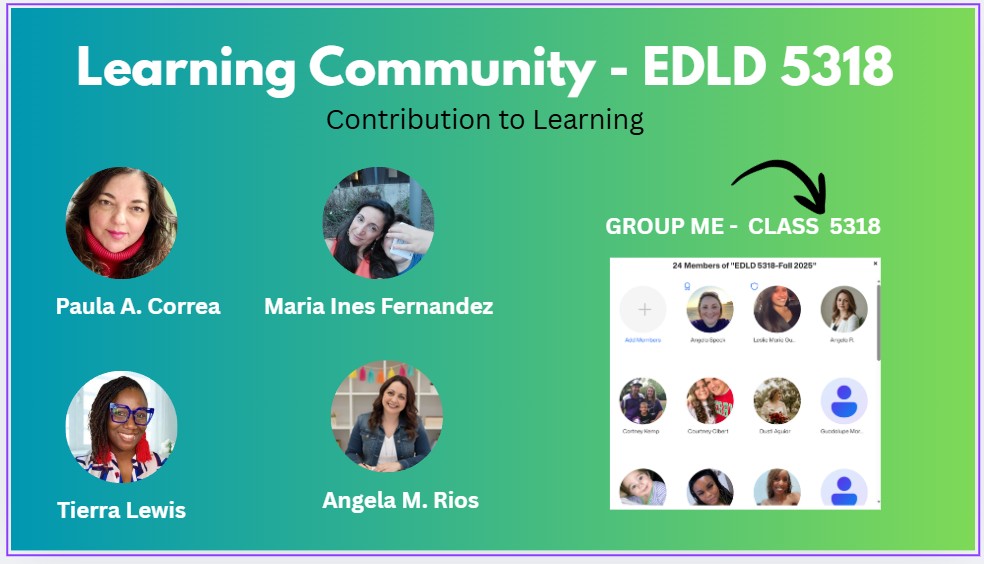
Figure 1
Learning community members and GroupMe collaboration.
As I reflect on EDLD 5318, I feel proud of my growth and confident in the skills I have developed. This course strengthened my ability to design meaningful online learning experiences and deepened my understanding of what it means to be a self-directed, reflective learner. I look forward to applying this knowledge with my families, colleagues, and school community.
Thank you, Dr. Bellard, for your guidance, clarity, and encouragement throughout this journey. Your support made a significant difference in my learning experience.
📚 References
Fink, L. D. (2013). Creating significant learning experiences: An integrated approach to designing college courses (2nd ed.). Jossey-Bass.
Wenger, E. (1998). Communities of practice: Learning, meaning, and identity. Cambridge University Press.
.