
Introduction
Throughout the EDLD 5315 course, I had the opportunity to deepen my understanding of action research and the role of reflective practice in improving educational environments. This course challenged me to think more intentionally about how educators can identify meaningful problems of practice, analyze their root causes, and design research that leads to purposeful change. As I engaged with the readings, discussions, and learning activities, I began to see how action research can serve as a powerful tool not only for improving instruction but also for fostering continuous professional growth.
This reflection allows me to evaluate my contributions to my own learning and to the learning community throughout the course. Self-assessment is an important part of becoming a self-directed learner because it requires honest reflection on what is working well and what can be improved. As Fink (2013) explains, learners must develop the ability to assess the quality of their own work in order to grow as independent and lifelong learners.
In the following reflection, I explain the score I selected for my participation in this course, discuss how I contributed to my own learning and to the learning of my peers, and identify areas where I can continue improving as an active member of a collaborative learning community.
Self-Assessment Score: 95
After reviewing the self-assessment marking guide and reflecting on my participation throughout this course, I believe a score of 95 accurately represents my level of engagement and contribution to both my own learning and to the learning community. Throughout the course, I consistently completed the required readings, videos, and learning activities while actively participating in discussions and collaborative exchanges with my peers. I also worked intentionally to connect course concepts, such as action research and reflective practice, to my innovation project, Tech Time: My Time in Kindergarten, which focuses on creating structured technology routines that support independence and engagement in young learners.
In addition to completing all course assignments and activities on time, I made an effort to provide thoughtful contributions in discussion forums and respond to classmates in ways that encouraged reflection and dialogue. These interactions helped strengthen my understanding of the course concepts while also contributing to the collective learning of the group. I also revisited and refined several of my ideas as my understanding of action research developed throughout the course.
While I believe my contributions met the expectations described in the marking guide, I recognize that there is always room for continued growth, particularly in expanding dialogue with peers and integrating additional research sources into discussion responses. For these reasons, I believe a score of 95 reflects both my commitment to the course and my ongoing growth as a reflective and self-directed learner.
Connecting My Learning Across EDLD 5315 and EDLD 5320
Because I am currently enrolled in both EDLD 5315 and EDLD 5320, many of the ideas and collaborative conversations from both courses naturally connected and strengthened my learning experience. While EDLD 5315 focused on developing my understanding of action research and identifying a meaningful problem of practice, EDLD 5320 provided opportunities to document, reflect on, and share my learning through my ePortfolio and course artifacts.
These two courses complemented each other in meaningful ways. The work I developed in EDLD 5315, particularly related to clarifying my research problem and designing an action research approach, directly influenced the reflections and artifacts I included in my ePortfolio for EDLD 5320. At the same time, the reflective process encouraged in EDLD 5320 helped me think more intentionally about how to communicate and organize my learning from EDLD 5315.
Collaboration with classmates also supported these connections between courses. While the two courses had different class groups, the discussions and collaborative exchanges in both environments helped strengthen my learning. In EDLD 5315, the larger class environment allowed for a broad exchange of ideas related to innovation and action research. In EDLD 5320, the smaller class setting allowed for deeper dialogue and more personalized feedback as we developed our ePortfolios.
Through discussions and interactions with peers such as Jennifer Haden, Thomas, Maria Ines Fernández, Tierra Lewis, Simon, and Guadalupe, I was able to explore ideas that applied across both learning experiences. Our exchanges helped me see how innovation, reflection, and research can work together to support meaningful change in educational practice.
Engaging in both courses simultaneously allowed me to approach my learning in a more integrated way. Rather than viewing each course separately, I was able to connect the concepts, discussions, and assignments in ways that strengthened my understanding of innovation, research, and reflective professional practice.
Contributions to the Learning Community
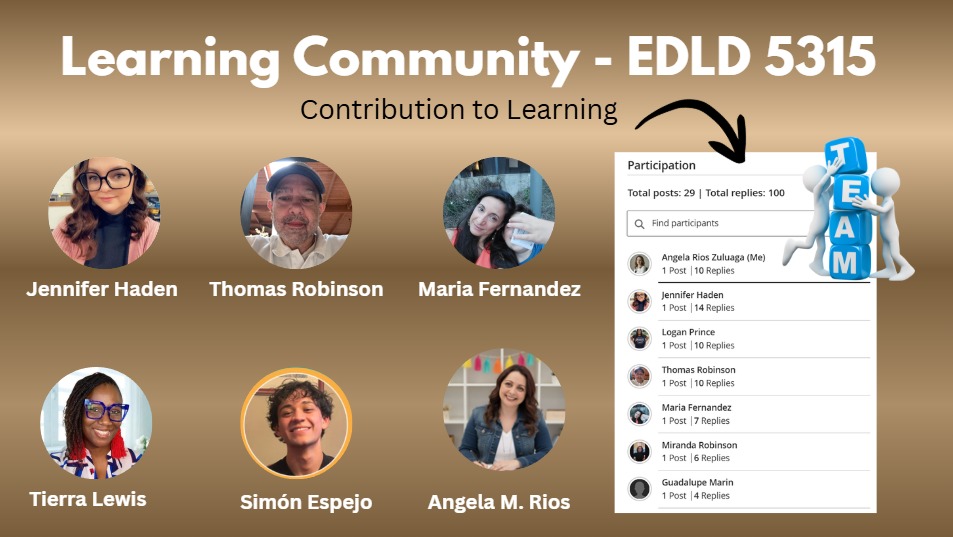
An important part of my learning in this course came from the opportunity to collaborate and learn alongside my classmates. The discussions and collaborative activities allowed me to exchange ideas, reflect on different perspectives, and consider how the concepts presented in the course connect to real educational contexts. These interactions helped me deepen my understanding of action research and the importance of reflective practice in improving teaching and learning.
Throughout the course, I interacted most frequently with Jennifer Haden, Thomas, Maria Ines Fernández, Tierra Lewis, Simon, and Guadalupe. Reading their reflections and engaging with their ideas helped me see how educators from different backgrounds approach similar challenges in their professional environments. These exchanges encouraged me to think more critically about my own innovation project and to consider new ways of approaching research and problem solving in education.
In addition to the course discussion forums, many of us stayed connected through a GroupMe communication group, which became a helpful space for collaboration and support. Through this informal communication channel, we were able to ask questions, clarify assignments, and share ideas when we needed guidance. This space helped strengthen our sense of community and reminded me that learning is often enhanced when we support one another through open communication and collaboration.
During the discussions, I tried to contribute in ways that supported the learning of others by sharing reflections, asking questions, and connecting course concepts to my own professional experience as a kindergarten educator. Many of my reflections connected the ideas from the course to my innovation project, Tech Time: My Time in Kindergarten, which focuses on creating structured technology routines that support independence and confidence in young learners.
These collaborative exchanges reminded me that learning communities are built through dialogue, reflection, and the willingness to learn from one another. Through these interactions, I was able not only to deepen my own understanding but also to contribute to a supportive environment where we could all grow as educators and researchers.
Reflection on What Is Working and What I Can Do Better
One of the aspects that worked well during this course was my ability to remain engaged and committed to the learning process. I consistently completed the readings, videos, and course activities, and I made an intentional effort to connect these ideas to my professional context as a kindergarten educator. The process of identifying and clarifying a problem of practice helped me better understand how action research can serve as a meaningful tool for improving educational environments and supporting student learning.
Another positive aspect of my learning experience was the opportunity to reflect on my own practice and refine my thinking over time. As I worked through the course activities, particularly those related to problem clarification and research design, I revisited my initial ideas and refined them to better align with the goals of my innovation project. This process helped me see how reflection and revision are essential parts of professional growth and continuous improvement.
At the same time, this reflection also helped me identify areas where I can continue improving as a self-directed learner. One area for growth is continuing to expand dialogue with peers by engaging in additional discussion responses that extend conversations and explore ideas more deeply. While I consistently participated in discussions, I recognize that deeper dialogue and follow-up questions can further strengthen collaborative learning within the community.
Another area for improvement involves continuing to integrate research and scholarly sources more frequently into my reflections and discussion responses. Although I connected many of my ideas to course concepts and professional experiences, I can continue strengthening my contributions by consistently incorporating additional research that supports and expands my thinking.
Overall, this course reinforced the value of reflective practice, collaboration, and continuous learning. It reminded me that professional growth is an ongoing process that requires curiosity, openness to feedback, and a willingness to refine our ideas over time. As I continue my journey as an educator and as a learner in the Applied Digital Learning program, I remain committed to applying these principles in ways that support both my own growth and the learning of those around me.
Links to Artifacts
The following artifacts provide evidence of my learning, collaboration, and development of my action research project throughout EDLD 5315.
⬜ Clarifying the Problem – Collaborative Discussion
⬜ Action Research Design Outline
⬜ Literature Review Planning Document
⬜ Innovation Project: Tech Time
Reference
Fink, L. D. (2013). Creating significant learning experiences: An integrated approach to designing college courses. Jossey-Bass.