
By Angela M. Ríos Zuluaga
🌱1. Overview / Project Description
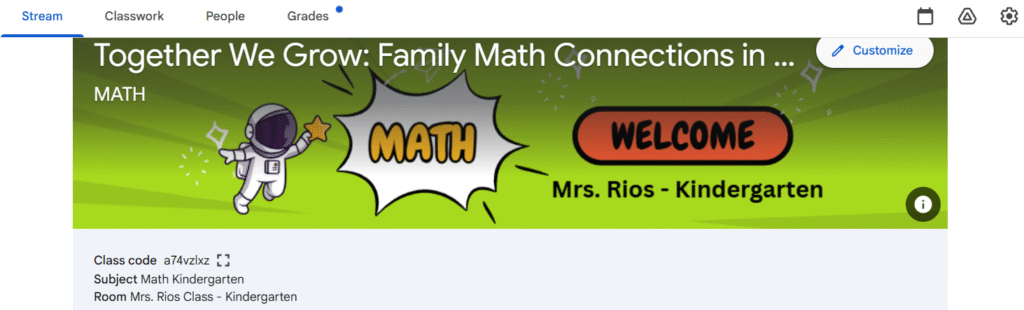
Together We Grow is a bilingual, visual, and family-friendly online course designed to support Kindergarten families as they reinforce early math skills at home.
This project was developed for EDLD 5318 – Instructional Design, with the goal of creating a meaningful blended learning experience rooted in:
- COVA + CSLE
- Fink’s Significant Learning
- Mayer’s Multimedia Principle
- Assessment as Learning
Because many of my families have limited technology experience, every part of the course was intentionally designed to be simple, visual, bilingual, and accessible. Google Classroom served as the ideal LMS due to its familiarity, mobile-friendliness, and intuitive navigation.
🌐 2. Learning Management System (Google Classroom)
Enter Google ClassroomI chose Google Classroom because it allows families to:
- Navigate with minimal digital skills
- Access bilingual instructions
- Use QR codes easily
- View videos, images, and short tasks
- Complete activities using their phones
- Interact without creating additional accounts
This LMS aligns with equity and accessibility, reducing barriers and ensuring all families can participate fully.
3. Start Here Module
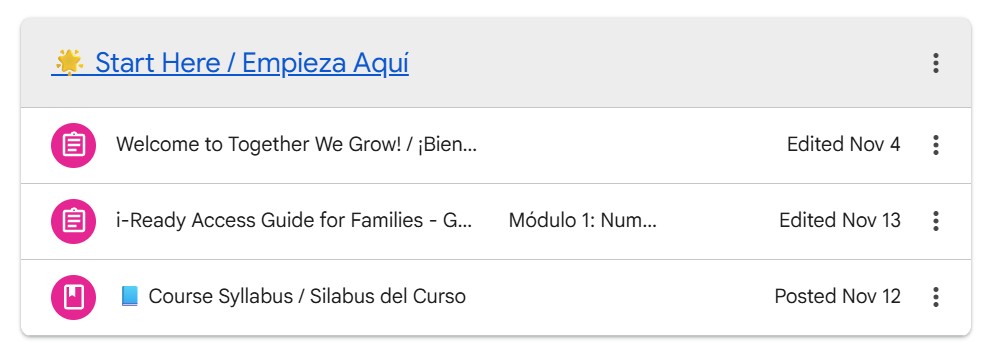
The Start Here section introduces families to:
- Welcome video
- Course purpose and expectations
- A Google Form about home math routines
- Instructions for navigating the modules
- Links to i-Ready and Family Math Practice
- A simple step-by-step guide for entering activities
This module was designed using Mayer’s Multimedia Principle to reduce cognitive overload through:
- Clean and simple layout
- Short videos
- Minimal text
- Bilingual captions
- Visual icons
4. Implementation Video
Below is my narrated screen-capture video demonstrating the Start Here module, Modules (1-5), and the instructional design decisions behind the course.
🔢 5. Instructional Modules (1–5)
Although the assignment required only the first two modules, I created all five modules because I intend to implement this course with my real families. The full structure provides consistency and developmental progression.
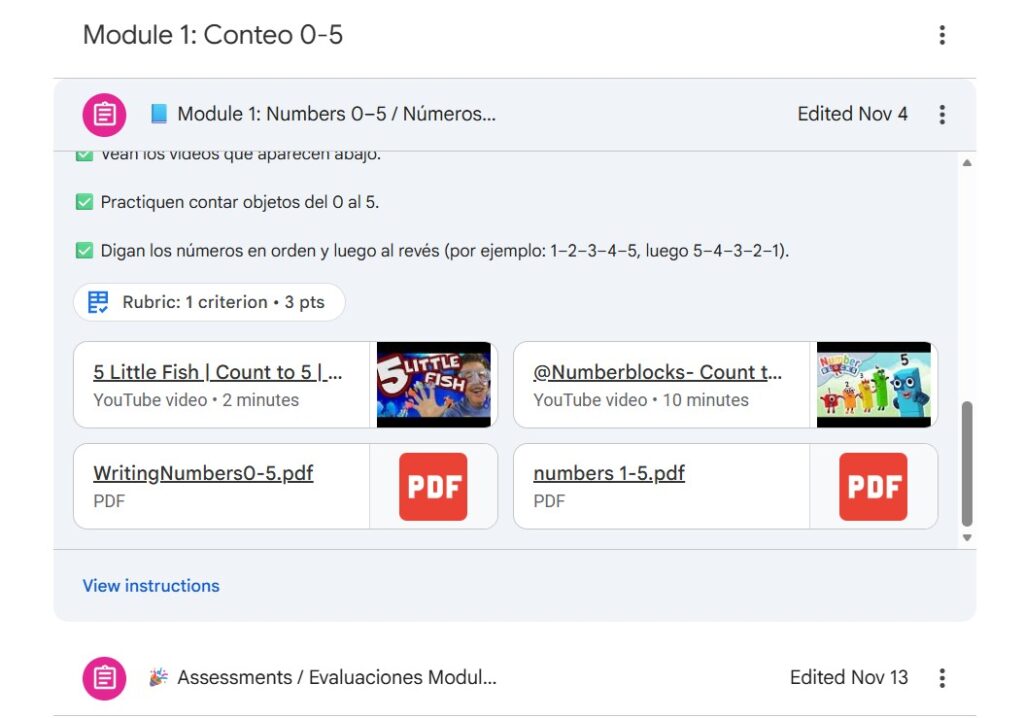
Module 1 – Numbers 0–5
- Counting song
- Hands-on counting with household objects
- QR videos
- Short assignment
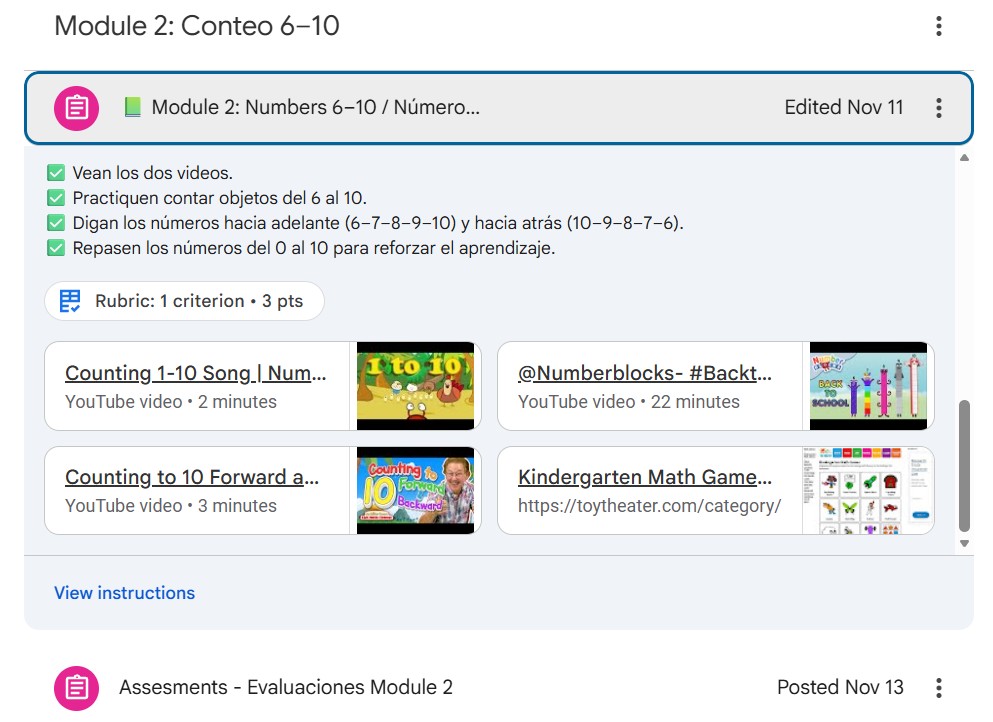
Module 2 – Numbers 6–10
- Number writing and recognition
- Number order games
- i-Ready task
- Digital activities
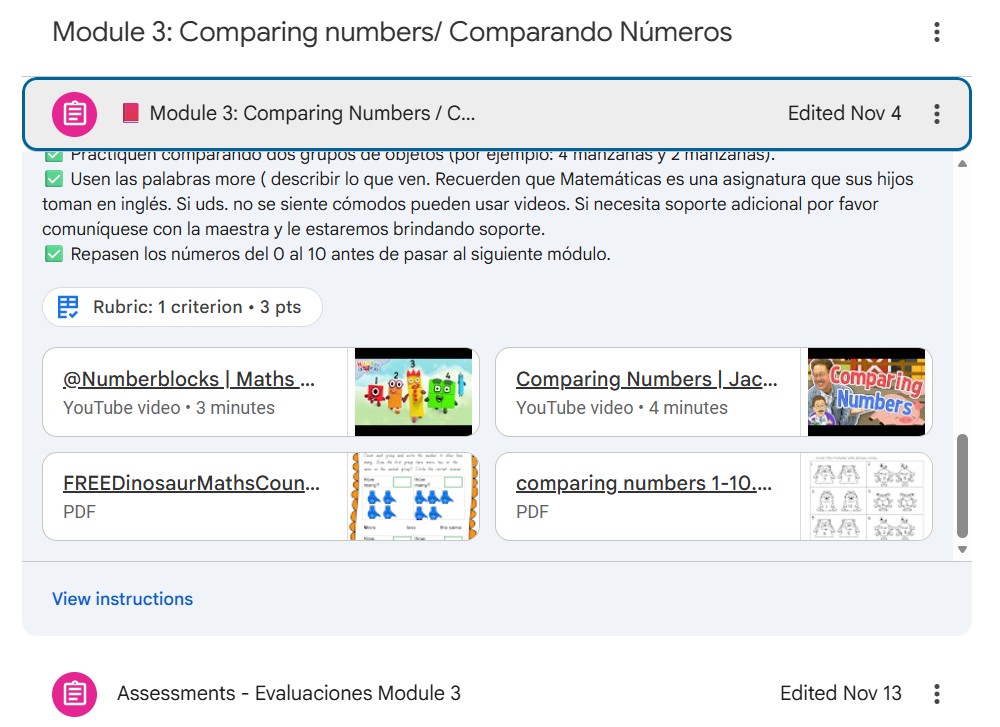
Module 3 – Comparing Numbers (0–10)
- Compare sets using real objects
- Visual representations
- Practice identifying more/less
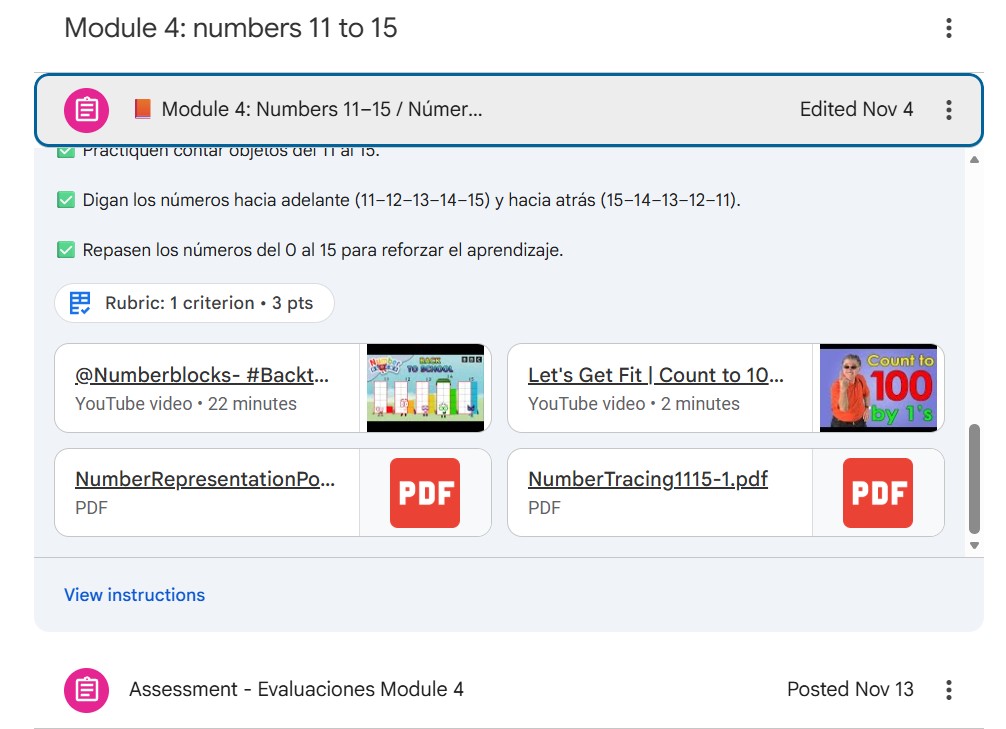
Module 4 – Numbers 11–15
- Teen numbers through tens + ones
- Ten-frame visuals
- Practice writing numbers
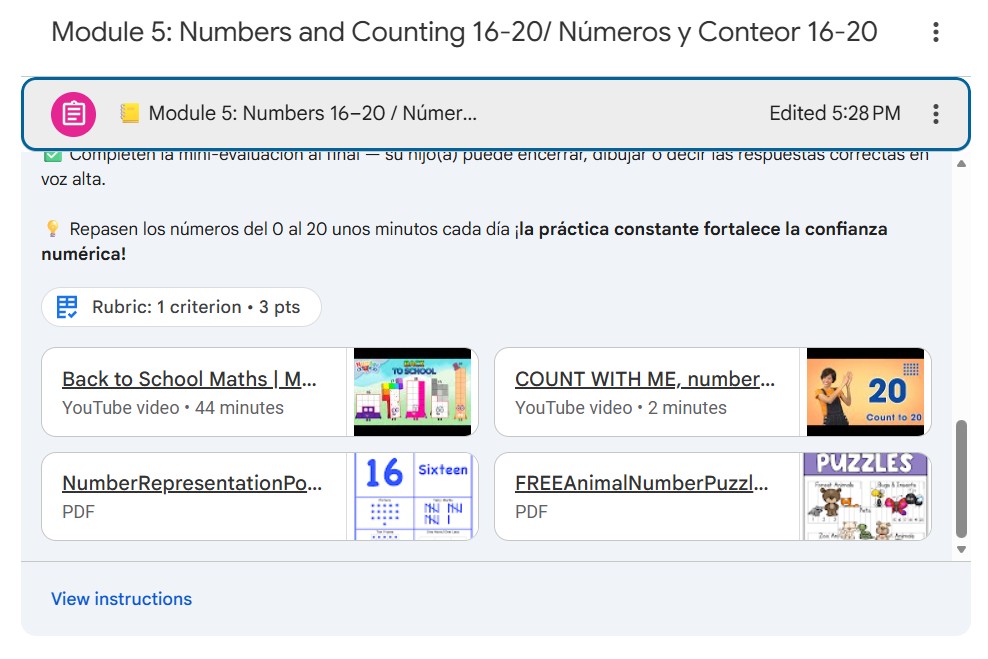
Module 5 – Numbers 16–20
- Completing the sequence
- Recognizing, writing, and counting
- Real-life counting tasks
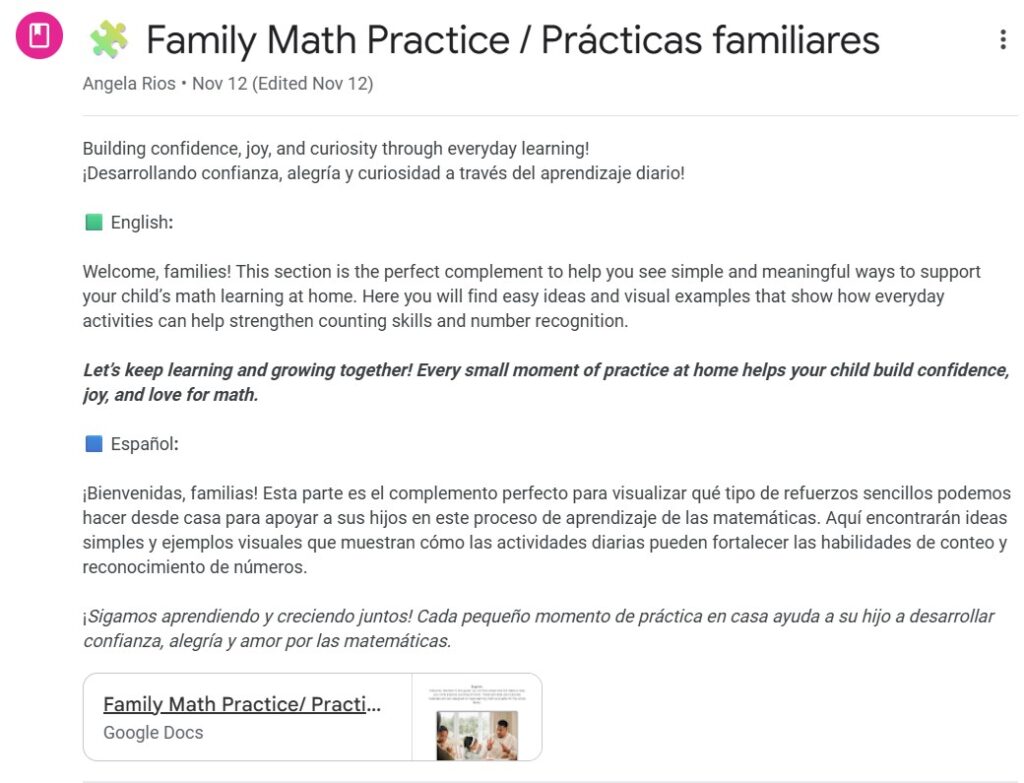
6. Family Math Practice / Prácticas familiares
Designed to help families strengthen math learning using objects already in their home, such as:
- Fruits or cereal
- Toys
- Buttons
- Steps
- Cups or utensils
Activities support authentic learning, reinforcing math in real-life routines.
🧮 7. Assessment Design
✔️ Module Assessments
Each module includes a small assignment, such as counting, identifying numbers, or uploading a photo/video.
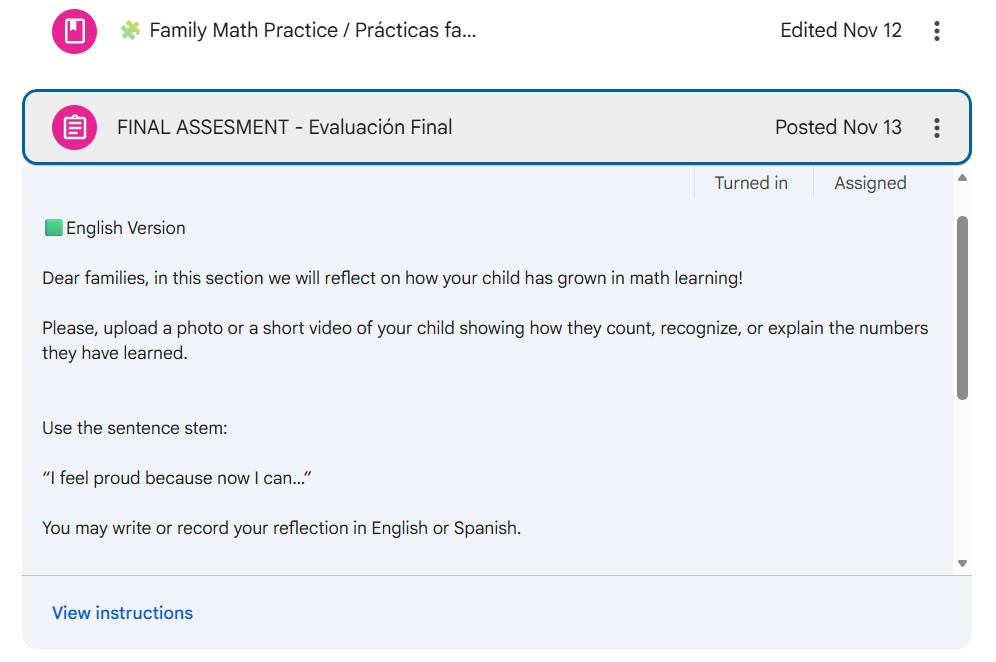
✔️ Final Assessment
Families upload:
- A short video or photo showing the child’s learning
- A brief reflection describing how they felt during the experience
This promotes Assessment as Learning, giving space for reflection and ownership.
📘 8. Updated Fink’s 3-Column Table
🌱 Fink’s 3-Column Table
Together We Grow: Family Math Connections in Kindergarten
Open Fink’s 3-Column TableLearning Outcomes
By the end of the course, families/students will:
- Recognize, count, and write numbers 0–20
- Compare quantities
- Understand number order
- Use authentic learning with household objects
- Build independence and confidence
- Reflect on learning growth
Learning Activities
- videos
- Counting songs
- QR activities
- Hands-on counting
- Ten-frame practice
- Digital games
- Family Math Practice
- Mini assignments
- Final reflection
Note: Activities are delivered across five modules (0–5, 6–10, Comparing Numbers, 11–15, 16–20).
Assessment
- Module mini assignments
- Photos and videos
- i-Ready tasks (optional)
- Final Assessment + family reflection
- Ongoing informal engagement
🌿 9. Reflection
Designing and implementing Together We Grow has been a meaningful experience that allowed me to authentically connect instructional design theories with the real needs of my Kindergarten families. One of the biggest lessons I learned is that effective learning environments must be intentionally designed to support the learner’s context. Because many of my families have limited technological experience, simplicity and clarity became essential design principles. This aligns with Mayer’s Multimedia Principle, which emphasizes reducing unnecessary cognitive processing to support essential learning (Mayer, 2009).
Another important insight that emerged during this process was recognizing how technological access and language barriers directly influence the learning experience for my families. Many of my parents have limited exposure to digital tools and speak only Spanish at home, which often leads to uncertainty or hesitation when supporting math learning that they perceive as “English only.” These realities reinforced the importance of designing a course that is not only bilingual, but visual, intuitive, and emotionally supportive. This understanding strengthened my commitment to creating materials that reduce anxiety, build confidence, and position technology as an accessible tool rather than an obstacle. Integrating these considerations into my instructional design allowed me to better honor the diverse linguistic and technological needs of my community.
Using Google Classroom as my LMS helped me create an accessible, bilingual, and visually friendly environment. The Start Here module was designed to welcome families, reduce cognitive overload, and provide clear expectations using short videos, icons, and step-by-step navigation. These decisions were guided by Bates’ (2015) recommendation that digital learning environments should be easy to enter, intuitive, and intentionally structured to promote learner success.
Fink’s 3-Column Table was essential in ensuring alignment between learning outcomes, activities, and assessments. This framework helped me design each module with purpose and coherence, allowing families to understand how every activity supported their child’s progress (Fink, 2013). The Family Math Practice section is one of my favorite parts of the course because it incorporates real-life, hands-on experiences using familiar household objects. This creates opportunities for authentic learning at home, which aligns with the principles of CSLE and promotes relevance and ownership for families (Harapnuik, 2016).
The final assessment invited families to upload a video or photo showing their child’s growth and encouraged them to share how they felt during the learning experience. This mirrors the idea of assessment as learning, where reflection and self-awareness become part of the learning itself.
Overall, this project helped me grow as a designer and facilitator of learning. I learned how to blend theory with empathy, and how to design in ways that honor the linguistic, cultural, and technological realities of my community. I feel proud of this work and excited to continue building meaningful digital learning experiences for my students and their families.
Closing sentence
Thank you for joining me on this journey. This project was created with love for my families and my little explorers.

Gracias por acompañarme en este viaje. Este proyecto fue creado con amor por mis familias y mis pequeños exploradores.
📚 References
Bates, A. W. (2015). Teaching in a digital age: Guidelines for designing teaching and learning. Tony Bates Associates Ltd. https://opentextbc.ca/teachinginadigitalage/
Fink, L. D. (2013). Creating significant learning experiences: An integrated approach to designing college courses (2nd ed.). Jossey-Bass.
Harapnuik, D. (2016). COVA and CSLE learning framework. Digital Learning and Innovation. https://www.harapnuik.org
Mayer, R. E. (2009). Multimedia learning (2nd ed.). Cambridge University Press.