
Tech Time: My Time in Kindergarten
EDLD 5389 – Developing Effective Professional Leadership
Instructor: Dr. Dwayne Harapnuik
1. Introduction: Purposeful Learning in My Context
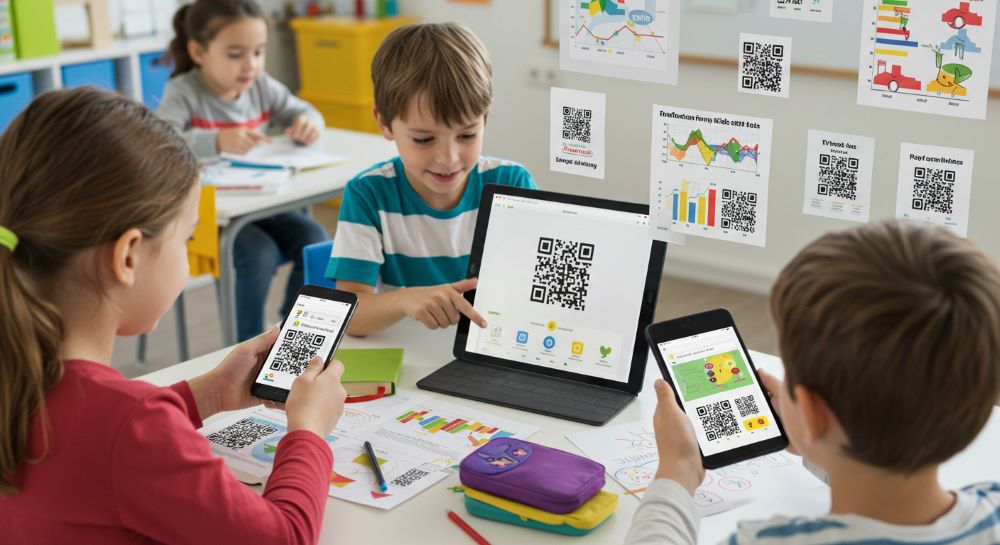
The purpose of this Professional Learning (PL) Strategy is to support kindergarten teachers in implementing Tech Time: My Time in Kindergarten, an innovation focused on developing student independence with digital learning tools through QR codes, structured routines, and blended learning stations. This innovation responds to an authentic classroom challenge: young learners often struggle to navigate digital tools without high teacher supervision. Strengthening their autonomy gives teachers more time for targeted instruction while children build confidence, digital fluency, and ownership over their learning.
This page serves as the central hub for educators who want to explore, understand, and implement this innovation. It brings together all components of my PL strategy in one cohesive space. This work reflects my development as a self-differentiated leader and aligns with Harapnuik’s belief that learning flourishes when individuals have choice, ownership, voice, and authentic experiences through the COVA + CSLE model.
2. Overview of My PL Strategy
Tech Time: My Time in Kindergarten prepares young learners to navigate technology independently by using predictable, developmentally appropriate routines supported by QR codes and blended centers. This strategy supports more equitable access to digital learning in early childhood settings and promotes purposeful engagement.
3. Alignment to the Five Key Principles of Effective Professional Learning
This PL Strategy was intentionally designed using Gulamhussein’s (2013) five principles of effective professional learning:
1. Extended Duration
A 6–8-week cycle includes modeling, practice, coaching, reflection, and continuous refinement.
2. Support During Implementation
Teachers receive ongoing coaching, modeling, co-teaching, videos, and hands-on guidance.
3. Active Engagement
Teachers participate as learners scanning QR codes, exploring centers, and building routines.
4. Modeling
Live classroom demonstrations show real Kinder transitions, language, expectations, and independence practices (McCammon, 2015).
5. Grade-Level Specificity
All strategies are designed for kindergarten, reflecting developmentally appropriate practice and TEKS alignment.
4. Original & Updated Go & Show / Alternative PL Presentations
These two presentations illustrate the evolution of my professional learning design and how my communication strategy became more intentional over time. As I deepened my understanding of effective PL through Gulamhussein’s five principles and the Alternative PL model, I refined not only the structure of the sessions but also the clarity, tone, and depth of the message I wanted teachers to experience.
Original Presentation (Go & Show)
This initial version was created to introduce the core idea of Tech Time: My Time in Kindergarten and to establish the purpose of integrating more intentional digital routines in the classroom.
It presents the early vision of a simple, cyclical “Go & Show” structure, where teachers apply an activity, gather evidence, and return to reflect. This draft reflects my starting point before fully incorporating extended duration, ongoing support, teacher modeling, and active engagement as recommended in high-impact PL design.
Updated Version (Alternative PL Strategy)
The updated version includes extended implementation timelines, intentional modeling, QR-based practice sessions, and deeper alignment with the 5 principles of PL. This version reflects a more complete understanding of how sustained, meaningful professional learning should be structured (Gulamhussein, 2013).
PL SESSIONS SLIDE DECK by Angela Rios5. Audience and Their Needs
The primary audience for this Professional Learning (PL) Strategy consists of kindergarten teachers who are navigating the unique demands of early-childhood instruction. These educators work with young learners who require structure, repetition, visual supports, and consistent routines in order to develop independence. Because technology use in early childhood must be intentional and developmentally appropriate, teachers need practical guidance that aligns with how young children learn, explore, and build autonomy.
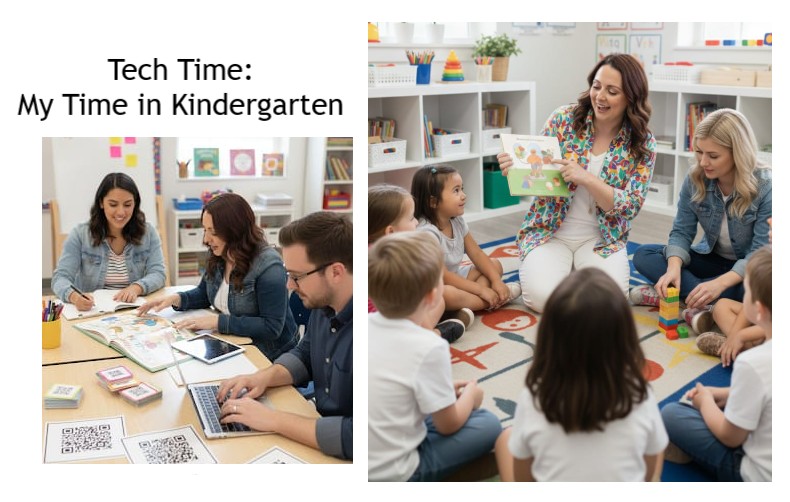
Participants in this PL Strategy benefit from resources and supports that allow them to implement Tech Time: My Time in Kindergarten with confidence and clarity. Their most significant needs include:
- Practical, classroom-ready examples that show how QR codes, station rotations, and blended routines can be introduced step-by-step in a developmentally appropriate way.
- Visual modeling and demonstrations that help teachers understand how to introduce devices, routines, and expectations to five-year-olds through gradual release and hands-on modeling.
- Easy-to-implement QR materials that reduce planning time and allow teachers to quickly integrate digital learning opportunities into their daily schedules.
- Structures for collaboration and reflection, such as “Go & Show” checkpoints, peer conversations, and shared exemplars from real classrooms.
- Scaffolding and coaching during early implementation, especially as students learn to log in, navigate apps, manage devices, and transition between stations.
- Clear routines and behavior supports that help teachers manage the classroom while students work independently on devices.
These needs shaped every component of the PL Strategy to ensure relevance, feasibility, and authenticity. In alignment with Harapnuik’s emphasis on learning through choice, ownership, voice, and authentic experiences, the design prioritizes teacher autonomy, real classroom modeling, and ongoing support during implementation (Harapnuik, n.d.).
6. Fostering Collaboration and Modeling

Collaboration and modeling are key components of this Professional Learning (PL) Strategy because teachers learn new practices more effectively when they work with colleagues, observe real examples, and reflect on instructional decisions together. This PL provides multiple opportunities for shared learning through weekly reflection sessions, peer observations, classroom video demonstrations, “Go & Show” evidence cycles, and optional co-teaching opportunities.
Modeling is especially important in kindergarten settings, where teachers benefit from seeing routines demonstrated in authentic, age-appropriate contexts. These collaborative structures create a supportive professional community in which educators build confidence, refine their practice, and strengthen their ability to help young learners develop independence with technology.
7. Fostering Self-Directed Learning (Visual Summary)

This PL Strategy intentionally incorporates the COVA model by encouraging teachers to explore digital tools independently, make choices about implementation, and collect evidence from their own classrooms. These practices strengthen ownership, agency, and authentic engagement (Harapnuik, n.d.).
Self-directed learning is supported through opportunities such as:
- Exploring QR tools and blended learning routines
- Engaging in reflection prompts
- Taking ownership of Go & Show evidence
- Providing input on classroom routines and transitions
- Applying new practices authentically in their own teaching contexts
Self-directed learning is not only about learning new tools; it also involves an internal commitment to professional transformation. Teachers move beyond doing things simply because “we have to” and instead connect their actions to purpose, meaning, and continuous improvement. When educators are given meaningful opportunities to make decisions, reflect, and lead small changes in their classrooms, they strengthen their ability to influence their learning environment.
Setting personal growth goals, monitoring progress, and collaborating with colleagues supports a culture of collective growth. This mindset of ongoing improvement empowers teachers to become change leaders who introduce, refine, and sustain innovative practices within their teams.
This active stance toward learning and continuous growth naturally extends into the idea of distributed leadership. When teachers develop ownership of their professional learning, they are better prepared to step into leadership roles that support collaboration and strengthen the overall implementation of the PL Strategy.
8. Leadership Roles
A distributed leadership structure supports the successful implementation of this PL Strategy. Each role contributes to building shared responsibility, modeling new practices, and fostering ongoing collaboration among teachers. This structure ensures that all participants experience guidance, autonomy, and collective ownership throughout the process.
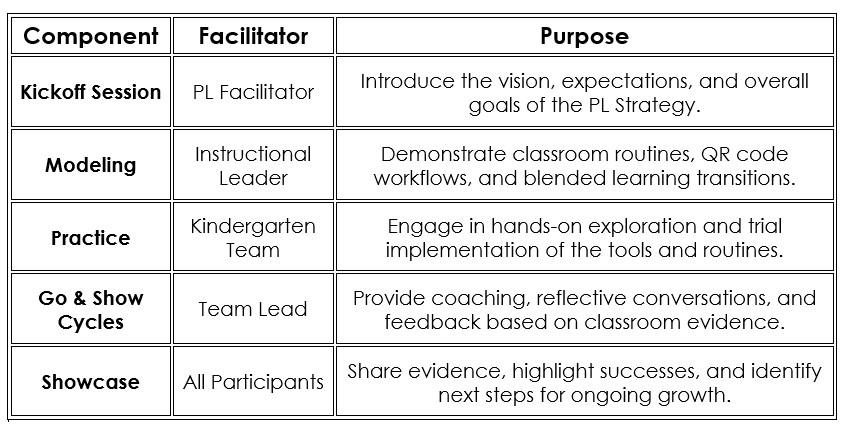
This distribution of responsibilities promotes shared leadership while supporting teachers through the change process. It aligns with research indicating that effective professional learning requires active participation, ongoing modeling, and context-specific support (Gulamhussein, 2013).
Building on this shared leadership structure, the next section presents how the UbD framework guides the instructional design behind this innovation and turns the vision into actionable steps for classroom practice.
9. Frameworks Supporting the PL Strategy
This PL Strategy aligns with key frameworks from the ADL program that guide intentional instructional design and long-term vision.
BHAG (Big Hairy Audacious Goal)
Provides the long-term direction and aspirational vision for strengthening digital independence in kindergarten classrooms.
Fink’s 3-Column Table
Helps clarify the learning goals for teachers, the evidence they will produce, and the learning experiences that support those outcomes.
Understanding by Design (UbD)
UbD is the main framework used to design this PL Strategy. It structures the work through backward design, ensuring alignment between goals, evidence (Go & Show), and the learning experiences teachers will engage in.
Together, these frameworks support a coherent and purposeful PL Strategy that promotes meaningful teacher growth and practical implementation.
10. Implementation Schedule and Timeline
The following 8-week implementation timeline supports the extended duration recommended for effective professional learning. It provides teachers with time to learn, practice, reflect, refine, and demonstrate progress throughout the PL Strategy.
This schedule reflects Gulamhussein’s (2013) findings that sustained duration and ongoing support are essential for meaningful instructional change.
Schedule and Timeline
Transition to Next Section
This 8-week timeline provides the sustained duration and structured support needed for meaningful change. With a clear sequence from vision to classroom implementation, the next section highlights how these elements come together to create a cohesive and actionable Professional Learning Strategy.
11. PL Session Slide Decks
This section provides access to all slide decks used throughout the PL Strategy. Each deck is designed to support modeling, exploration, collaboration, and reflection as teachers implement Tech Time: My Time in Kindergarten. These presentations guide each session and serve as reusable resources for continued professional learning.
Included Slide Decks
- Kickoff Session: Introduces the innovation, goals, expectations, and purpose of the PL Strategy.
- QR Exploration: Hands-on practice with QR codes, routines, and digital station workflows.
- Modeling: Demonstrates effective transitions, teacher facilitation, and student independence routines.
- Reflection & Coaching: Guides teachers through collaborative review, adjustments, and peer feedback.
- Final Showcase: Used to share evidence, celebrate growth, and plan next steps for continued implementation.
12. Professional Learning: Modules That Connect Vision to Practice
The Professional Learning Strategy for Tech Time: My Time in Kindergarten is structured as a series of interconnected modules designed to bridge the gap between vision and classroom practice. Although these modules are organized as weekly sessions within a 6–8 week timeline, each one serves a specific purpose in helping teachers transition from understanding the innovation to successfully applying it with students. Gulamhussein (2013) emphasizes the importance of structured, sequential learning opportunities that allow teachers to build knowledge over time, receive support, and engage in meaningful practice. This modular design reflects those principles.
Each module builds upon the previous one, ensuring that teachers experience professional learning that is cumulative, practical, and developmentally appropriate for early childhood contexts. The sequence includes:
Module 1: Vision & Foundations
Teachers explore the purpose of Tech Time, examine challenges in digital independence, and connect the innovation to student needs. This module establishes clarity and shared direction.
Module 2: Modeling Digital Routines
Live demonstrations and recorded examples show teachers what effective QR routines, transitions, and expectations look like in a real kindergarten classroom. As McCammon (2015) notes, modeling is essential for helping teachers internalize new instructional practices.
Module 3: Hands-On Exploration
Teachers engage with QR codes, blended centers, and station routines as learners. This experiential module aligns with research emphasizing active engagement in professional learning (Gulamhussein, 2013).
Module 4: Go & Show Cycle 1—Application in Context
Teachers implement one routine in the classroom, collect evidence, and reflect on student responses. This module strengthens ownership and authenticity, aligning with the COVA + CSLE model (Harapnuik, n.d.).
Module 5: Coaching, Feedback, and Reflection
Teachers receive personalized support, share successes and challenges, and refine routines. This targeted support increases confidence and builds community.
Module 6: Go & Show Cycle 2—Deepening Practice
Teachers expand implementation, gather new evidence, and analyze growth in student independence.
Module 7: Refinement and Collaborative Problem-Solving
Teachers work together to refine procedures, troubleshoot issues, and improve transitions and digital routines based on classroom realities.
Module 8: Final Showcase & Next Steps
Teachers present their evidence, highlight student progress, and plan sustainable next steps to continue strengthening Tech Time routines.
By structuring the PL Strategy into interconnected modules, this design ensures teachers experience a meaningful progression from understanding the innovation to applying it authentically in their classrooms. These modules anchor the work, provide clarity, and build momentum—turning vision into sustainable practice.
13. Resources Needed
This resource library provides teachers with the tools and supports required to successfully implement Tech Time: My Time in Kindergarten. These materials strengthen consistency, promote student independence, and ensure alignment with instructional goals and TEKS expectations.
Implementation Resources Included
Digital Tools & Templates
- QR code templates for stations and routines
- Editable labels for devices, bins, and QR workflows
- Sample routines for technology independence
Instructional Alignment
- TEKS alignment guide for digital learning in kindergarten
- Sample lesson connections for Math, Science, and Social Studies
- Developmentally appropriate expectations for technology use
Classroom Support Materials
- Anchor charts for routines, transitions, and digital citizenship
- Visual cues for Chromebook handling and station expectations
- Checklists for student independence and technology readiness
Reflection & Evidence Tools
- Teacher reflection sheets for Go & Show cycles
- Peer coaching prompts and collaboration forms
- Self-assessment rubrics for instructional progress
Modeling & Demonstration
- Short classroom videos demonstrating routines
- Sample station maps and classroom setup examples
- “Before and After” visuals showing improved station flow
14. The Role of Learning Communities in Professional Growth
Effective professional learning depends on the presence of a supportive learning community where teachers feel safe to explore new ideas, ask questions, and reflect deeply on their instructional decisions. In early childhood settings, learning communities strengthen teacher practice by creating shared spaces where educators can observe, discuss, and test strategies that respond to the unique needs of kindergarten learners. Research shows that collaboration is essential during implementation because teachers require time, dialogue, and ongoing support to internalize new instructional strategies (Gulamhussein, 2013).
Within this Professional Learning Strategy, the learning community serves as the foundation for growth. Teachers engage in weekly reflections, Go & Show evidence cycles, peer observations, and collaborative problem-solving aligned to real classroom challenges. These shared activities promote a culture of trust, authenticity, and continuous inquiry. Harapnuik’s COVA + CSLE model highlights the importance of learning within meaningful, authentic, and socially connected environments in which teachers exercise choice, ownership, and voice (Harapnuik, n.d.).
Through the learning community, teachers gain confidence in implementing blended learning routines, see examples of effective practice, and refine their approaches based on feedback and multiple perspectives. These collaborative experiences sustain the innovation and ensure that Tech Time: My Time in Kindergarten becomes an evolving, long-term practice rather than a one-time initiative. Ultimately, the learning community transforms professional development into a shared, ongoing journey where teacher growth directly enhances student learning.
15. References
Agarwal, R. (2014). Writing and publishing scientific articles: A guide for graduate students and early career researchers. Springer.
American Psychological Association. (2020). Publication manual of the American Psychological Association (7th ed.). American Psychological Association.
Gulamhussein, A. (2013). Teaching the teachers: Effective professional development in an era of high stakes accountability. Center for Public Education. https://www.nsba.org
Harapnuik, D. (n.d.). COVA + CSLE resources. http://www.harapnuik.org
Harapnuik, D. (n.d.). Who owns the ePortfolio? http://www.harapnuik.org/?page_id=6050
Lowenthal, P. R. (2015). Social scholarship: Reconsidering scholarly practices in the digital age. Learning, Media and Technology, 40(3), 342–357. https://doi.org/10.1080/17439884.2015.1050037
McCammon, L. (2015). The power of modeling in professional learning. Educational Leadership, 72(2), 68–72.
Rios Zuluaga, A. M. (2025). Tech Time: My Time in Kindergarten – Innovation Plan. Digital Explorers ePortfolio.
Rios Zuluaga, A. M. (2025). Tech Time: My Time in Kindergarten – Professional Learning Strategy Presentations (Go & Show and Alternative PL). Digital Explorers ePortfolio.